Meta Description: Discover how diffusion language models like Google Gemini Diffusion and Mercury achieve 10x faster text generation than traditional LLMs, while autoregressive models dominate image generation in 2025.
Diffusion language models (DLMs) are revolutionizing text generation with speeds up to 10x faster than traditional autoregressive large language models. While Google’s Gemini Diffusion and Inception’s free Mercury platform lead the charge in parallel text generation, an interesting twist has emerged: autoregressive models now outperform diffusion in image generation.
This comprehensive guide explores how diffusion language models work, their key advantages over autoregressive LLMs, flagship models you can use today, and why autoregressive approaches surprisingly dominate image generation in 2025.
What Are Diffusion Language Models?
Diffusion language models adapt the proven diffusion process from image generators like Stable Diffusion to discrete text tokens. Unlike traditional LLMs that generate text one word at a time, DLMs generate entire sequences in parallel through iterative refinement.
The Diffusion Process for Text
The training process involves two key phases:
Forward noising: Clean text tokens are progressively masked or corrupted over multiple timesteps until the sequence becomes completely random.
Reverse denoising: A Transformer model learns to predict and refine the original sequence, iteratively removing noise to reveal coherent text.
This parallel generation approach enables DLMs to produce entire token blocks simultaneously rather than sequentially, dramatically reducing latency.
Key Technical Innovations
Diffusion language models use bidirectional attention, allowing every token to condition on the full sequence during generation. This contrasts sharply with autoregressive models’ left-to-right causal masking.
Advanced techniques enhance DLM capabilities:
- Diffusion-of-Thought (DoT) integrates chain-of-thought reasoning across denoising timesteps for flexible compute-reasoning tradeoffs
- Block diffusion hybrids interpolate between autoregressive and full diffusion for variable-length outputs with KV caching
- Adaptive caching (dLLM-Cache) reuses stable tokens across iterations, achieving up to 9x speedups on models like LLaDA-8B
Most DLMs require 10-50 denoising steps during inference, though optimizations continue reducing this overhead.
Diffusion Language Models vs Autoregressive LLMs: Key Advantages
1. Dramatically Faster Inference Speed
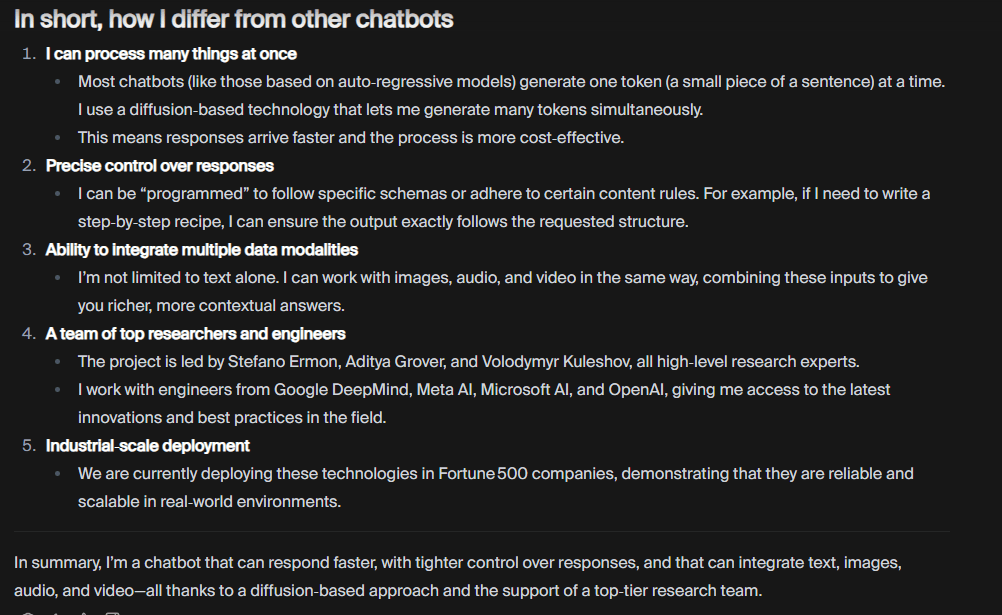
The most compelling advantage of diffusion language models is speed. While autoregressive models generate text sequentially with inherent latency bottlenecks, DLMs refine entire blocks simultaneously.
Mercury, the world’s first commercial diffusion LLM, achieves over 1,000 tokens per second on H100 GPUs—delivering 5-10x faster throughput than comparable autoregressive models.
2. Superior Error Correction
Iterative refinement allows DLMs to self-correct hallucinations mid-process. Unlike autoregressive models where early errors propagate through the sequence (exposure bias), diffusion models can revise their entire output during denoising.
Diffusion-of-Thought models have beaten larger autoregressive models on mathematical reasoning benchmarks like GSM8K, demonstrating improved accuracy alongside speed gains.
3. Enhanced Controllability and Editing
Diffusion language models natively support:
- In-context editing and text infilling
- Multimodal extensions for combined text-image generation
- Reward-guided generation via trajectory resampling
- Better control over output structure and formatting
This makes DLMs particularly powerful for applications requiring iterative refinement, such as code generation, long-form content editing, and structured output generation.
4. Improved Data Efficiency
Research shows diffusion models excel in low-data regimes, better utilizing repeated training samples for downstream tasks. This makes them more practical for specialized applications with limited training data.
Benchmarks demonstrate DLMs matching autoregressive perplexity with smaller model sizes, and code generation strategies like Saber achieve 251% speedups while maintaining quality.
Top Diffusion Language Models in 2025
Google Gemini Diffusion: Commercial-Scale Text Generation
Google DeepMind’s Gemini Diffusion pioneers commercial-scale text diffusion technology. This flagship model generates coherent token blocks rapidly, performs error correction on-the-fly, and excels at mathematical reasoning and code editing tasks.
Key capabilities:
- Outpaces Gemini 2.0 Flash-Lite in speed benchmarks
- Superior performance on non-agentic evaluation tasks
- Native support for structured output and editing workflows
Access the demo waitlist at https://deepmind.google/models/gemini-diffusion/
Mercury: Free Commercial Diffusion LLM
Inception Labs’ Mercury represents a breakthrough as the world’s first freely available commercial diffusion language model. Accessible at https://chat.inceptionlabs.ai/, Mercury delivers impressive performance metrics:
- 10x faster than autoregressive models (1,000+ tokens/second)
- Superior accuracy on reasoning and code generation benchmarks
- Drop-in compatibility with RAG pipelines and agent frameworks
- Competitive with GPT-4o and Claude while using fewer computational resources
Mercury’s Transformer architecture enables parallel denoising across the full context, making it ideal for developers building production AI applications.
The Autoregressive Comeback: Image Generation in 2025
While diffusion models revolutionize language generation, autoregressive approaches surprisingly lead image generation quality and efficiency in 2025.
Why Autoregressive Models Excel at Images
Modern autoregressive image generators like LlamaGen (3.1B parameters, 2.18 FID on ImageNet) and NextStep-1 (14B parameters) outperform diffusion giants like Flux.1 and Stable Diffusion 3 through scalable next-token prediction on visual tokens.
Superior efficiency: Sequential generation with beam search and pruning requires fewer evaluations than diffusion’s multi-step denoising. A 2B parameter autoregressive model can surpass 12B parameter diffusion models.
Better quality at scale: Models using raster scanning and continuous tokens (Infinity, VAR) achieve 0.89 GenEval scores compared to diffusion’s 0.83, handling high-resolution generation more effectively.
Faster generation: Autoregressive models produce images in seconds rather than minutes. Hybrid approaches like HART refine autoregressive bases in just 8 denoising steps.
Natural language editing: Models like Fluid, Janus-Pro-7B, and Token-Shuffle enable intuitive object addition and removal with text prompts, rivaling DALL-E 3’s editing capabilities.
The Vibeops.one JSON Prompt Breakthrough
A notable experiment demonstrated why autoregressive models excel with structured image generation. We used JSON prompts to create precise 9-square image grids:
{
  "grid": [
    {"pos": 1, "prompt": "red apple"},
    {"pos": 2, "prompt": "blue sky"},
    ...
    {"pos": 9, "style": "photorealistic"}
  ]
}
Diffusion models struggled with positional fidelity, confirming autoregressive superiority for structured visual layouts.
The technique particularly shines with raster-scan tokenization, where the autoregressive model naturally follows left-to-right, top-to-bottom generation patterns.
Conclusion: The Hybrid Future of AI Generation
The future of AI generation isn’t about choosing between diffusion and autoregressive approaches—it’s about using each where they excel. Diffusion language models deliver unprecedented speed and controllability for text and code, while autoregressive models provide superior precision and efficiency for images.
This complementary relationship powers the next generation of scalable, production-ready AI applications. Join the Gemini Diffusion waitlist, test Mercury for free today, and start prototyping hybrid workflows that leverage both paradigms.
 VibeOps
Leave a comment